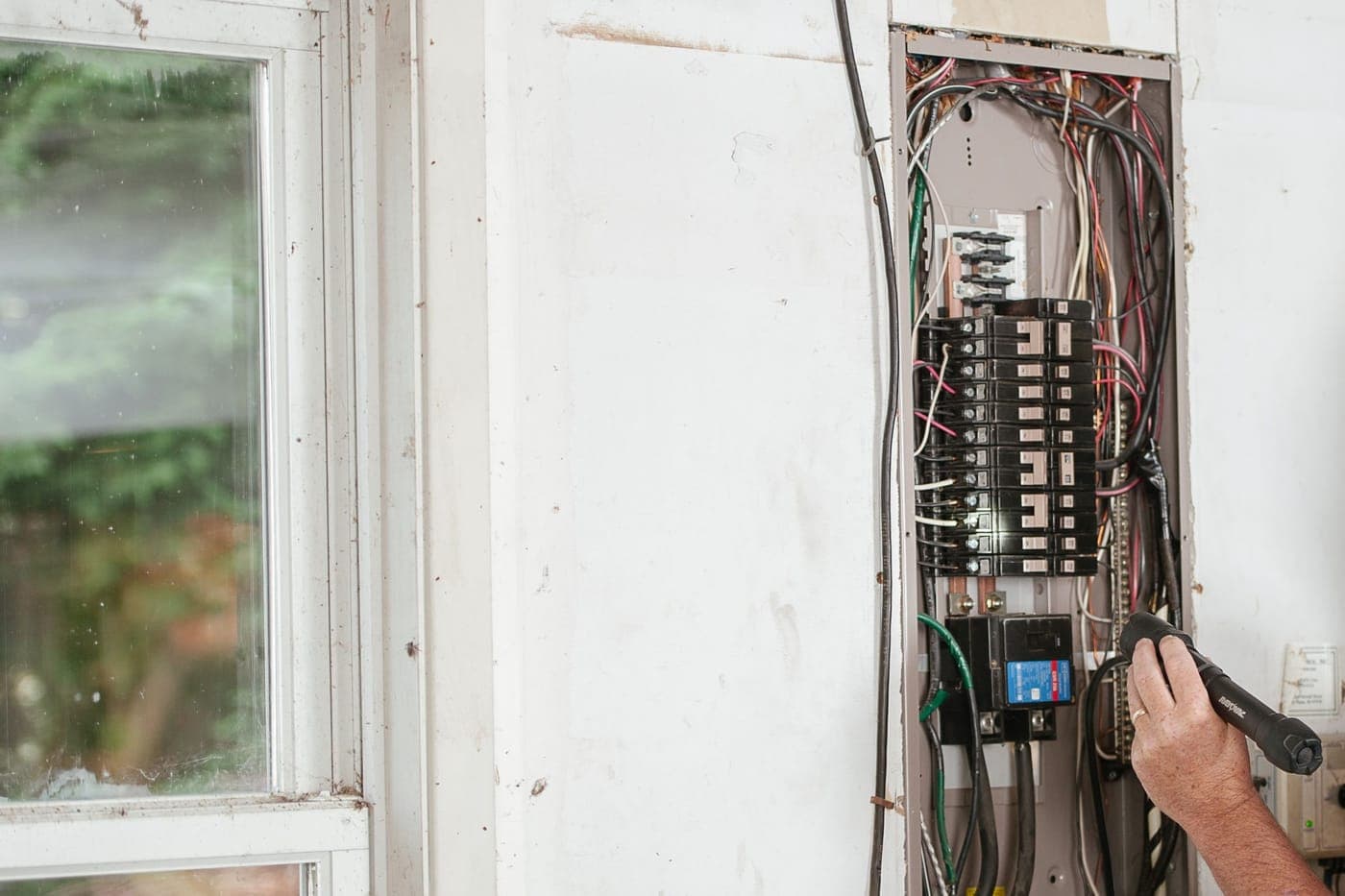
When a breaker trips every time the microwave and toaster run together, or an outlet suddenly goes dead for no apparent reason, the root cause can usually be identified. We troubleshoot the entire system before replacing any parts, because installing a new breaker or receptacle will not fix a loose connection located further down the line.
The most common causes of electrical failure include a loose connection at a wall outlet or switch, a tripped ground-fault (GFCI) device elsewhere on the circuit that has cut power to downstream receptacles, an overloaded circuit, a worn-out breaker, or a damaged cable. If your house is old enough to contain it, we will also check the branch circuits for hazardous aluminum wiring.
Troubles can also originate where the main power enters your home. Utility power arrives in two separate 120-volt legs. If you lose one of these halves, roughly half of your lights and outlets will go completely dead and your 240-volt appliances will stop working—typically without a single breaker tripping—a condition electricians refer to as a dropped phase.
What This Covers
- Dead outlets, lights and circuits
- Breakers that trip repeatedly or won't reset
- Flickering lights, steady or now and then
- Burning smells and warm or scorched outlets
- Buzzing or crackling at the panel
- Half the house without power (a dropped phase)
- Ground-fault (GFCI) and arc-fault (AFCI) devices that keep tripping
Signs It’s Time to Call
- A breaker trips more than once for the same reason
- Lights flicker in several rooms, or more often than they used to
- An outlet is dead, loose, warm, or sparks when you plug something in
- You notice a burning or fishy smell with no obvious source
- Half the house loses power, or some lights go bright while others dim
The Process
Note When It Happens
Before our visit, note when the problem occurs, which specific rooms are affected, and what appliances were running at the time. If the issue is intermittent, the time of day and prevailing weather conditions can help narrow down the root cause.
Follow the Circuit
The affected circuit undergoes thorough diagnostic testing, and its connections are opened up and inspected sequentially back to the breaker and the main panel. For electrical issues spanning the entire house, the troubleshooting process begins directly at the meter base and the main service breaker.
What It Is, and the Fix
You will receive a clear explanation of the exact fault and the recommended solution before any repair work begins. If the malfunction originates on the utility provider's side of the electric meter, the repair is the utility company's responsibility, and we will provide you with the exact details to report to them.
Repair, Then Run It Loaded
We perform the necessary repair and then test the circuit under a full operational load to confirm that the fault has been completely resolved.
Common Questions
Why did half my house lose power with no breaker tripped?
Each of the two 120-volt legs feeding your home supplies about half the circuits, and 240-volt appliances use both. When one leg fails, half the house goes dark and the range, dryer and air conditioner quit. Nothing is overloaded, so no breaker trips. The break may be on the utility's line or in your meter base, main breaker or panel. Report it to your electric utility, which can check its side.
If some lights get brighter while others dim, switch off the main breaker if you can reach it safely. That points to a failing neutral connection, which can put too much voltage on part of the house.
Why are my lights flickering?
Flicker in one fixture is usually the bulb, or an LED bulb on a dimmer that doesn't suit it. Lights that dip for a moment when the air conditioner kicks on are common and often harmless. Flicker across several rooms, flicker that's getting worse, or lights that get brighter as well as dimmer can mean a loose connection in the panel or at the service, and that needs attention soon.
Is a buzzing panel or a burning smell dangerous?
Yes. Buzzing, crackling, warmth, or a burning or fishy smell mean a connection is arcing or overheating, so treat it as urgent. If there's smoke or fire, get out and call 911. If the panel itself is hot, sparking or smoking, don't touch it: get out and call 911. Otherwise, switch off the affected circuit if you can do so safely, or the main breaker if you can't tell which circuit it is, and leave it off.
Then get in touch for an emergency repair. Call (404) 357-4144.