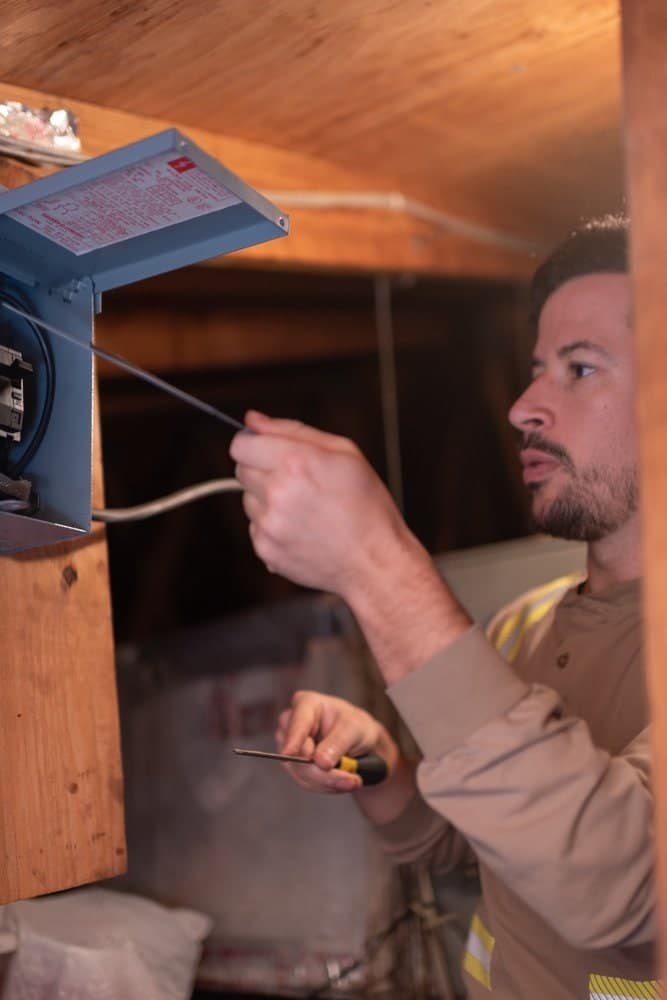
A tripping breaker is usually just doing its mechanical job—shutting down power when a circuit overloads or shorts to protect your wiring. However, breakers are mechanical parts that eventually wear out due to age, moisture, heat, and repeated tripping. You cannot fix an overloaded line simply by swapping the breaker; a new breaker will trip just the same if the underlying circuit fault remains. The breaker itself is defective and requires immediate replacement if it refuses to reset, has a loose handle, feels hot, buzzes, or shows scorch marks. Home inspection reports also frequently flag older panels where past DIY work resulted in the wrong size or type of breaker being forced into a slot.
Any replacement breaker must exactly match the manufacturer and type specified on your panel's label. Even if a different brand physically snaps into place, it will sit poorly on the panel's internal metal bus bar. This loose connection creates high electrical resistance, generating hidden heat that poses a severe fire hazard. If you notice any of these warning signs, turn off the circuit and contact me to replace it safely and correctly to code.
What This Covers
- Replacing a breaker that won't reset, hold or switch cleanly
- Replacing breakers that are hot, buzzing, corroded or scorched
- Single-pole and double-pole breakers for added circuits
- Correcting breakers that are the wrong size or type
- GFCI, AFCI and dual-function breakers in place of standard ones
- Separating two wires that share one breaker terminal
- Replacing a worn main breaker
Signs It’s Time to Call
- A breaker won't stay on, or trips again as soon as you reset it
- A breaker handle feels loose or won't click into place
- The panel buzzes or smells hot around one breaker
- A room loses power while its breaker still looks on
- An inspection report flags a mismatched or double-tapped breaker
- A new circuit needs a breaker
The Process
Locate the Breaker
Note which breaker it is, what it controls and what was running when it tripped, and read the brand off the label inside the panel door. The brand tells us which replacement breakers fit.
Find the Cause
I test the circuit and the breaker for an overload, a short circuit or a ground fault, and look at the bus bar behind the breaker for burned or degraded hardware.
Replacement and Testing
The new breaker matches the panel's listing and wire size. The circuit is run under load and the panel directory is brought up to date.
Common Questions
How can I tell if it's the breaker or the circuit?
You usually can't from the outside, though the timing is a clue. An overload trips after something's been running a while. A short circuit or ground fault trips right away. A worn breaker may trip under a light load, refuse to reset, or stay on while the circuit is dead.
If a breaker trips again right after you reset it, leave it off. Advanced testing of the breaker and circuit indicates the root cause, and that decides whether the fix is a new breaker, a repair on the circuit, or both.
Can I put in a bigger breaker so it stops tripping?
No. A breaker is sized to protect the wire behind it. Put a 30-amp breaker on wire meant for 20 amps and the wire can overheat long before the breaker reacts. When a circuit trips because it's carrying too much, the fix is often to move some of the load or add a circuit.
Can you replace a breaker in a Federal Pacific or Zinsco panel?
Replacement breakers are sold for both, but they don't cure the panel. With Zinsco, the weak point electricians report is the connection between the breaker and the bus bar, and a new breaker leaves that as it was. With Stab-Lok, independent testing has reported a high defect rate in replacement breakers as well as the originals.
A new breaker in either panel is a short-term repair at most and doesn't settle the concerns about the panel itself. Replacing the panel is usually the better long term answer.