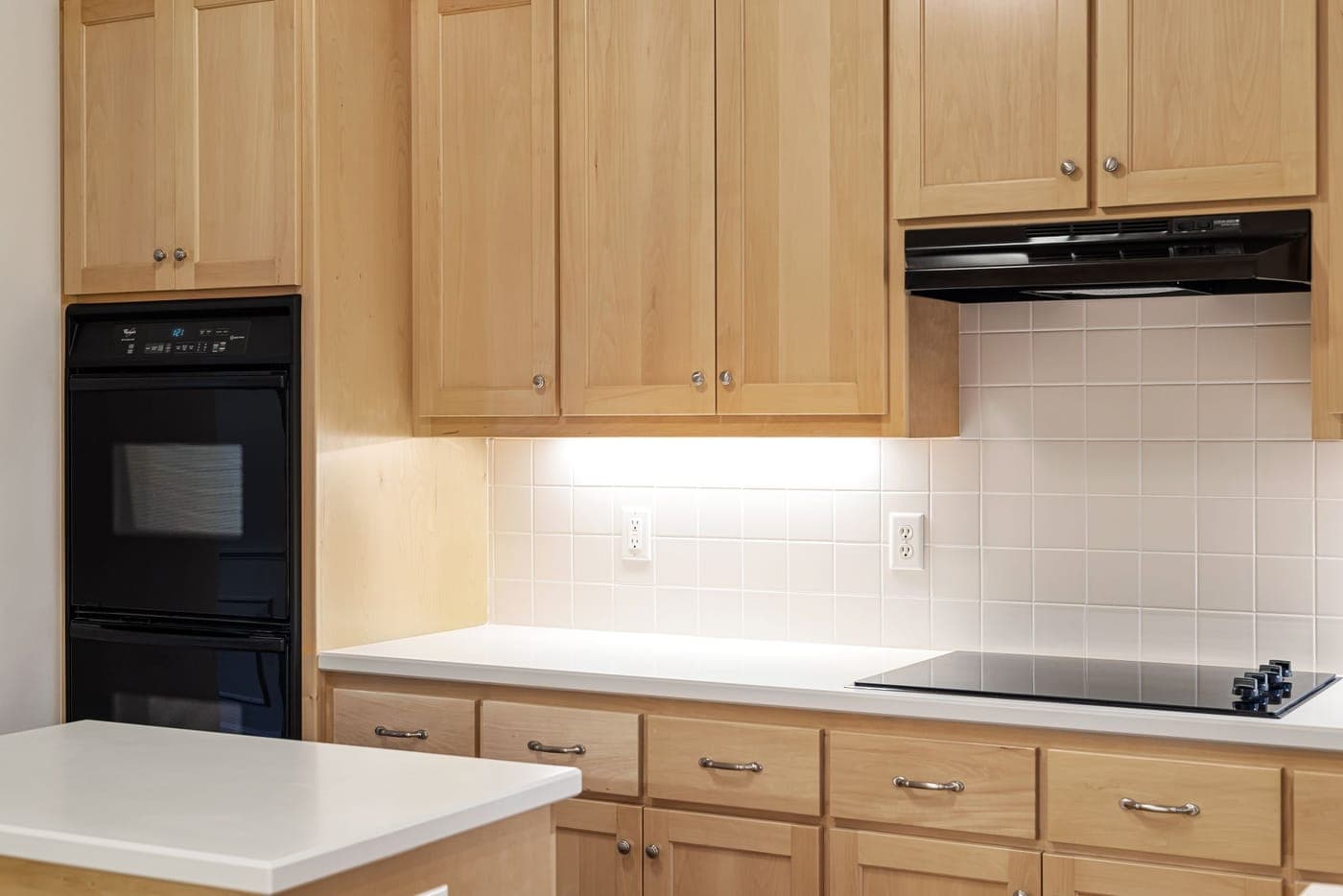
Accent lighting goes in most easily during a remodel, before the drywall, tile, and cabinets close up the spaces where its cable and drivers must go. This style of lighting uses LED tape or concealed small fixtures to illuminate specific features, such as a stone fireplace, the inside of a bookcase, a tray ceiling, or stair treads. However, it can also be added to rooms that are already finished.
Nearly all accent lighting runs on low voltage, drawing power from a driver or transformer that steps household power down, typically to 12 or 24 volts. The drivers require careful planning because each one must be sized for its specific load, long runs must be wired properly to prevent voltage drop at the far end, the dimmer must be compatible with the driver, and the driver itself must be installed in an accessible location for future maintenance.
What This Covers
- Cove and tray-ceiling lighting
- Lighting that washes a wall of stone, brick or art
- Shelf, niche, cabinet and toe-kick lighting
- Stair and handrail lighting
- Picture and display lighting
- Low-voltage drivers and transformers, sized and placed
- Dimming for layered lighting
- Replacing failed transformers and moving halogen systems to LED
Signs It’s Time to Call
- A remodel is coming and you want more than recessed lights
- A tray ceiling, niche or built-in has no lighting
- LED tape is dim at one end, flickers or has failed early
- An older low-voltage system hums, flickers or has stopped working
The Process
Choose What to Light
For each feature you want illuminated, we identify a ledge, cabinet lip, or stair nosing that can completely conceal the light source.
Size the Drivers
Once the fixture type, color temperature, and brightness levels are selected for each area, the drivers are sized and positioned, and the dimming system is engineered to match.
Rough In Before the Finishes
In a remodeling project, the cables and driver enclosures are installed before drywall, tile, and cabinetry are completed. In an already finished room, the cables are fished through the walls and the hardware is tucked away inside a cabinet, closet, or attic. Any wiring hidden inside a wall or ceiling must use cable specifically rated for that environment.
Tune the Dimming
We secure the LED tape and fixtures, test them across their full dimming range, and verify that the brightness remains perfectly even and the color temperature matches precisely from run to run.
Common Questions
What is cove lighting, and does my ceiling need to be built for it?
Cove lighting is an architectural technique that utilizes a concealed strip of LEDs placed on a ledge or behind a molding to throw light upward across the ceiling or downward along a wall. While tray ceilings and recessed soffits feature built-in ledges ready-made for this application, a flat ceiling can achieve the identical effect by installing architectural crown molding a few inches below the ceiling line. Because constructing the cove involves carpentry and wiring it requires electrical work, it is highly efficient to plan both phases of the project together.
Why is LED strip lighting dimmer at one end?
A long run of tape powered from only one end loses voltage along its length—a phenomenon known as voltage drop—which causes the far end to receive less power. This can be resolved by using shorter runs, upgrading to 24-volt tape, installing heavier gauge feed wire, or supplying power to the strip at multiple injection points.
Conversely, flickering indicates a different underlying issue. It is typically caused by a wall dimmer that is incompatible with the driver's specific dimming method, or a driver that is being overloaded by too much wattage.
Can my old low-voltage halogen lights be changed to LED?
Often, but not always by simply swapping the bulbs. Older 12-volt systems utilize transformers engineered specifically for the heavier electrical load of halogen lamps. Many of these electronic transformers require a minimum load to function properly, and modern LED lamps may draw too little power to trigger them, resulting in flickering, buzzing, or lights that refuse to turn on. Replacing the old transformer with a driver matched to the new lamps, or installing completely new fixtures, will resolve the issue.