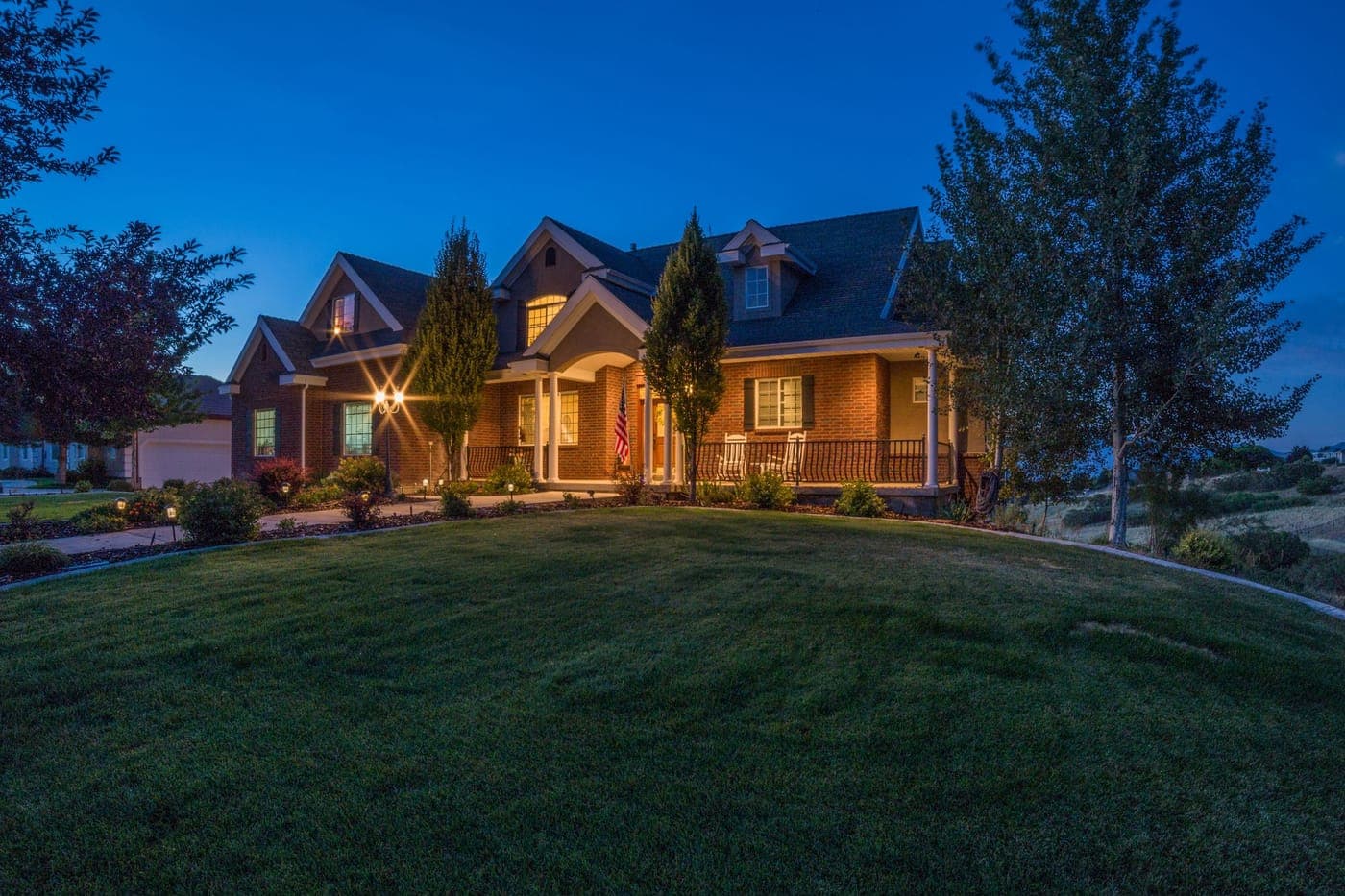
Many houses only feature a single porch light at each entrance. We build upon that foundation by installing comprehensive outdoor and landscape lighting, including path lights along walkways, downlights within the soffits, floodlights over the driveway, motion-activated security lights at the side and rear doors, and specialized fixtures for decks and stairways.
Fixtures mounted directly to the home, such as soffit lights and floodlights, operate on standard household line voltage. Conversely, path and garden lights typically run on low voltage, drawing power from a transformer located near the house that steps the voltage down and feeds the fixtures through a shallowly buried cable.
Any lighting fixture installed beneath a porch roof or an open soffit requires a damp-location rating, while any unit exposed directly to the elements requires a wet-location rating. Finally, before initiating any excavation or trenching with powered machinery, all buried utility lines must be located and marked by contacting Georgia 811.
What This Covers
- Pathway and garden lights on a low-voltage system
- Soffit and eave downlights
- Floodlights for driveways and yards
- Motion-sensor security lights
- Deck, step and patio lighting
- Landscape transformers, timers and photocells
- Weatherproof boxes, covers and GFCI-protected outlets
- Replacing rusted or failed outdoor fixtures
Signs It’s Time to Call
- Steps, walks or the driveway are dark at night
- The back or side of the house has no light at all
- A motion light stays on, or never comes on
- Path lights are dim, flicker or have stopped working
- An outdoor fixture is rusted, loose or has water in it
- A new deck or patio has no lighting yet
The Process
Walk the Outside Together
You show us what you want illuminated. We determine where power can be sourced from and evaluate how your existing outdoor outlets are currently protected.
Pick a Fixture for Each Spot
Each location receives a fixture rated specifically for its level of exposure. Where appropriate, you choose between household line voltage and low voltage, as well as between a timer, a photocell, or a motion sensor.
Trench and Run Cable
Cable for soffit and wall fixtures is routed through the attic or walls. Low-voltage cables are buried shallowly while household-voltage wiring is buried deeper; neither is installed until all utility lines have been located and marked.
Set the Sensors and Timers
We align floodlights and motion sensors to cover your property without spilling into a neighbor's windows, then calibrate the timers and photocells and test every fixture and GFCI device.
Common Questions
Should landscape lighting be low voltage or household voltage?
Low voltage is typically best for path, garden, and most deck lighting. These fixtures operate at around 12 volts, their cables require only about six inches of soil cover, and the lights can be easily moved or added to as your landscaping matures.
Household voltage is best suited for fixtures mounted directly to the house and lights that require greater power output. Wiring at this higher voltage must be buried significantly deeper—generally between 12 and 24 inches depending on the specific installation method and how the conduit is protected.
Do outdoor lights need GFCI protection?
Outdoor outlets do, and under Georgia's electrical code, that includes the specific receptacle a landscape transformer or a set of outdoor string lights plugs into. Any outlet fully exposed to the elements also requires an in-use cover that maintains a weatherproof seal even while a cord is plugged in.
Hardwired light fixtures are governed by different rules, as the code regulation covering general outdoor electrical equipment makes an explicit exception for lighting. However, any lighting installed near a swimming pool, spa, or water fountain is subject to its own much stricter safety requirements.
Can lights be added where there is no power outside?
Power for a new exterior fixture can be sourced from an indoor circuit—routed through the attic for soffit lighting or directly through the wall adjacent to a doorway. If the selected indoor circuit is already heavily loaded, a brand-new circuit must be run from the main panel. For a low-voltage system, you only need to locate or install a single GFCI-protected outdoor outlet to plug in the transformer.