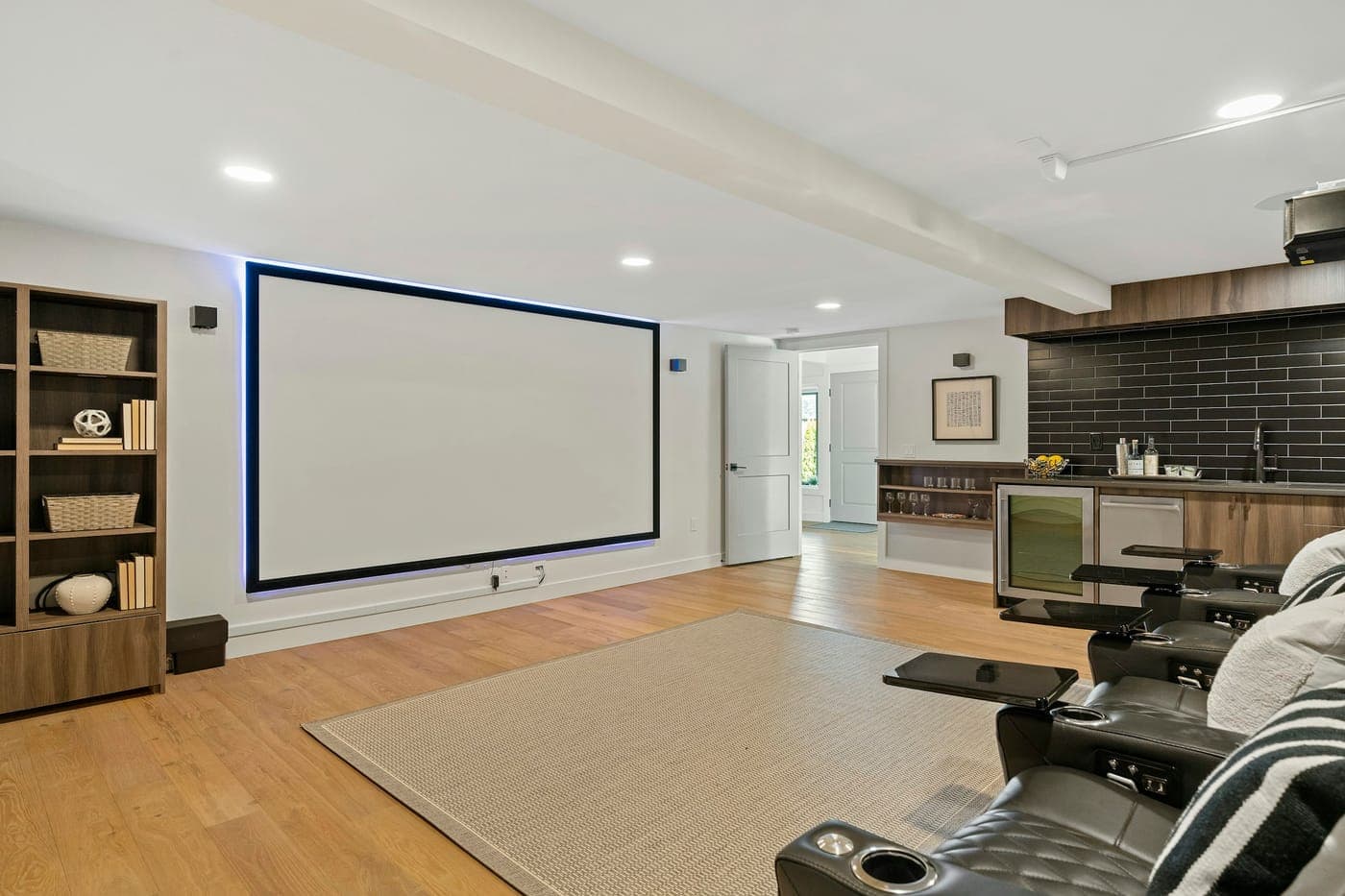
A wall-mounted television requires an outlet installed directly behind the screen, as running a standard power cord inside a wall cavity violates electrical codes. A ceiling-mounted projector requires an elevated receptacle for the exact same reason. While you or your audio-video (AV) installer select the media equipment, we handle all the underlying home theater wiring around it.
Surround sound speaker cable can be routed cleanly inside your walls and ceilings provided it features a CL2 or CL3 fire-safety rating printed on its jacket. While these lines are simplest to run before the drywall is hung, most finished rooms can still be successfully retrofitted with hidden wiring.
What This Covers
- In-wall and in-ceiling speaker cable for surround sound
- Wall plates at speaker and subwoofer locations
- Recessed outlets behind wall-mounted TVs
- Ceiling outlets for projectors and motorized screens
- Dedicated circuits for AV racks and amplifiers
- Power distribution at the equipment rack or closet
Signs It’s Time to Call
- You're finishing a basement or building a media room
- A TV is going on the wall and you don't want cords showing
- A projector is going on the ceiling with no outlet nearby
- Someone fished a power cord through the wall behind the TV
- The breaker trips or the lights dim when you turn the system up
The Process
Mark the Spots
The screen, seating, individual speakers, and AV equipment are marked on the walls and ceiling using your installer’s blueprint or the speaker manufacturer's recommended placement guidelines. You determine the TV's final height, and the electrical outlet is positioned directly behind where the screen will rest.
Read the Nameplates
The manufacturer nameplates on your equipment specify their exact power draw, which dictates whether an existing household circuit can handle the extra load or if your media rack requires a dedicated circuit run from the main panel.
Fish the Cable
Speaker, video, and network cables are fished inside the walls and ceiling, keeping them physically separated from standard power lines to prevent electrical hum and audio interference. Receptacles are installed precisely where needed for the TV, projector, subwoofer, and component rack.
A Label on Every Run
We apply a label to each individual speaker run at the equipment end for easy identification, then thoroughly test every new outlet and circuit. This allows your installer to hook up the components seamlessly without having to guess which wire connects to the rear left speaker.
Common Questions
Can I run my TV's power cord inside the wall?
No. The electrical code doesn't allow flexible cords, and that includes the TV's own cord and extension cords, to be hidden inside a wall or passed through a hole in one. The fix is an outlet behind the TV. Low-voltage cables such as HDMI can run in the wall as long as they're rated for it.
Does a home theater need its own circuit?
A TV, a soundbar and a streaming box don't; they're a light load. Amplifiers, powered subwoofers and a projector can add up to most of what one circuit carries, and that circuit is shared with other outlets and lights. If the breaker trips at high volume or the lights dim on heavy bass, a dedicated circuit to the rack is the common fix.
Is it too late to wire a room that's already finished?
A finished room can usually still be wired, by fishing cable through an attic above or a crawl space or unfinished basement below, sometimes with a few small access openings in the drywall. Rooms with no access above or below take more work.